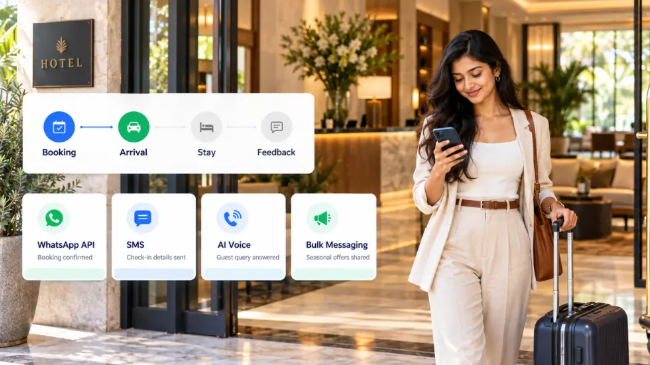

A guest books a room at 11 p.m. and refreshes their inbox twice. Nothing arrives, so the next morning they call the hotel, or book again somewhere else. At Acquaint Softtech, whose IT staff augmentation engineers often join hotel and travel tech teams to rebuild guest messaging, that silent gap after payment is one of the most common problems we are asked to fix.
A booking communication flow closes the gap. It sends the right message, on the right channel, at the right moment, from confirmation to checkout. This guide covers which messages every stay needs, how to choose between email, SMS, WhatsApp, and app push, the delivery architecture, consent rules, and cost.
Guests judge a hotel by its first message long before they see the lobby, and a confirmation that arrives late, twice, or in spam undoes the booking experience. The approach here draws on hospitality and customer-facing platforms that Acquaint Softtech has delivered as an Official Laravel Partner, with 1,300+ projects, 70+ in-house engineers, and clients across the USA, UK, Europe, and Australia who get a dedicated team within 48 hours of a brief.
What a booking communication flow is
A booking communication flow is the set of automated messages a hotel sends from booking to after checkout, each triggered by an event and delivered on the channel best suited to it. It replaces one-off emails sent by staff with rules the system applies to every reservation.
Transactional versus marketing
Transactional messages relate directly to a booking, such as a confirmation or check-in reminder. Marketing messages promote something new. The difference decides which consent rules apply and, on WhatsApp, which template category and price you pay, so classify every message before you build it.
The messages every stay needs
Every stay needs a small, predictable sequence of messages tied to real booking events. Sending fewer, well-timed messages builds more trust than sending many.
| Stage | Message | Trigger | Best channel |
| Booking | Confirmation | Payment succeeds | Email plus WhatsApp or SMS |
| Change | Modification or cancellation | Booking updated | Email plus the same short channel |
| Pre-arrival | Reminder with check-in details | Set days before arrival | WhatsApp or push |
| Arrival day | Room ready or digital key | Room assigned | Push or SMS |
| In-stay | Service replies | Guest request | |
| Post-stay | Receipt and review request | Checkout |
Choosing the right channel
Use email for the full record, SMS for short time-critical alerts, WhatsApp for conversational updates in markets where guests use it, and app push for guests with your app installed. Each channel has a clear strength and a clear constraint.
| Channel | Strength | Constraint |
| Full detail, receipts, universally available | Can land in spam if not authenticated | |
| SMS | Reaches any phone without an app | Short length, registration and consent rules |
| Rich, two-way, familiar to guests | Templates required outside a 24-hour window | |
| App push | Instant and free to send | Only reaches app users who allow it |
Fallback, not duplication
Send a message on the guest’s preferred short channel, and fall back to another only if delivery fails within a set time. Blasting the same confirmation across every channel at once feels like spam and trains guests to ignore you.
Email: the record of truth
The confirmation email is the guest’s practical and legal record of the booking, so it must be instant, accurate, and complete. Include the confirmation number, dates, room type, rate, total with taxes, cancellation policy, payment status, hotel contact details, and a link to manage the booking.
Get delivered, not filtered
Authenticate your sending domain with SPF, DKIM, and DMARC, the standards mailbox providers use to verify that mail really comes from you. Google and Yahoo made authentication a requirement for bulk senders in 2024. Send booking mail through a separate stream or subdomain from marketing, so a promotional campaign never drags confirmations into spam.
Make it machine-readable
Gmail supports schema.org reservation markup, including a LodgingReservation type, which lets the booking appear as a structured card after the sender registers with Google. Structured confirmations are easier for inboxes and assistants to read correctly.
SMS: short, urgent, and regulated
SMS is best for short, time-sensitive alerts such as a room-ready notice or a check-in code, and it carries some of the strictest registration and consent rules. Keep each text brief, name the hotel, and link to details instead of pasting them.
Register before you send
In the USA, business texting from standard 10-digit numbers requires A2P 10DLC registration, and unregistered traffic is likely to be filtered by carriers. Other countries set their own sender ID rules, so check each market before launch and always honor opt-out keywords such as STOP.
WhatsApp: templates and the 24-hour window
The WhatsApp Business Platform lets hotels send confirmations and updates, but any message sent outside a 24-hour customer service window must use a pre-approved template. The window opens when the guest messages you and resets each time they write again.
Pick the right template category
Templates are categorized as marketing, utility, or authentication, and a booking confirmation belongs in utility. Adding a promotion to a utility template can get it classified as marketing, which changes its price. Meta revises WhatsApp pricing periodically, so check current rates before budgeting.
Route replies to real people
WhatsApp is two-way, so guests will reply. Send their messages into a shared front desk inbox with the booking attached, so staff answers with context instead of asking for a confirmation number.
App push notifications
Push notifications are the fastest and cheapest channel, but they reach only guests who installed your app and allowed notifications. Both iOS and recent Android versions ask users for permission, so request it at a moment that makes sense, such as right after booking.
One codebase, both platforms
Each push should open the exact booking or digital key it refers to, not the app’s home screen. A cross-platform app built through React Native app development handles push, deep links, and booking screens for iOS and Android from one codebase.
The architecture behind reliable delivery
Reliable guest messaging runs on an event-driven notification service: booking events go in, and a rules layer decides which template, language, channel, and send time to use. The booking engine should never send messages directly.
1. The booking engine or PMS emits an event: booked, modified, cancelled, or checked in.
2. The notification service loads the guest’s preferences and consent.
3. Rules select the template, language, channel, and send time in the guest’s time zone.
4. The message is queued with an idempotency key, so a repeated event never sends twice.
5. The provider sends it, and delivery webhooks update its status.
6. A failure triggers the fallback channel or alerts staff.
Automate the plumbing
Teams that hire automation engineers can wire these triggers, retries, and fallbacks across the PMS and email, SMS, and WhatsApp providers without fragile hand-built scripts. Add quiet hours for non-urgent messages and keep templates per language, since WhatsApp approves each language version separately.
Consent, preferences, and privacy
Transactional booking messages generally do not require marketing consent, but promotional messages do, so store the two permissions separately. Give guests a preference center to choose channels and opt out of marketing without losing booking updates.
Send the minimum
Never include full card details in any message, and keep personal data in SMS and WhatsApp to what the guest needs. Consent and privacy rules differ by country, so confirm requirements for each market with legal counsel.
What it costs to build
The cost of a booking communication flow depends on how many channels, languages, and message types you support. Email and SMS confirmations with event triggers cost far less than a two-way, multi-channel platform.
| Scope | What you get | Typical range (USD) |
| MVP flow | Email and SMS confirmations, event triggers, templates, delivery tracking | $10,000 to $25,000 |
| Full platform | Two-way WhatsApp, app push, fallback rules, preference center, multilingual templates, analytics | $30,000 to $70,000 |
Where the savings are
Get confirmations and changes right on email and one short channel first, then add WhatsApp conversations and push. This staged build runs at up to forty percent cost savings versus Western agencies, with blended rates of roughly twenty-five to forty-nine US dollars per hour.
Proof: a customer notification app we built
Good guest messaging means customers stop calling to ask what is happening. Acquaint Softtech delivered that for 1st Choice Pest Solutions, a Wisconsin service company, through staff augmentation and mobile app development. The account below is drawn from the client’s 5.0 out of 5 Clutch review.
| Before the project | After the project |
| Technicians relied on printed schedules and phone calls back to the office | A technician app with schedules, checklists, photos, and reports, giving the office instant visibility |
| Customers had to call in for updates | A customer app with service tracking and reminders; customers appreciated notifications and digital summaries without calling |
| Scheduling, billing, and communication ran in separate systems | Backend integrations connecting scheduling, billing, and customer communication |
| Limited in-house capacity for new features | An augmented team of Laravel and mobile developers working inside the client’s workflow |
That was field services, not hospitality, and we say so plainly. The lesson transfers directly: event-driven notifications tied to one operational record, delivered to the customer’s phone, remove the anxious call that a missing hotel confirmation creates.
FAQs
What should a hotel booking confirmation include?
The confirmation number, dates, room type, rate, total with taxes, cancellation policy, payment status, hotel contact details, and a link to manage the booking. It should arrive within moments of payment.
Which channel is best for booking confirmations?
Email should always carry the full confirmation as the guest’s record. Add one short channel, such as WhatsApp or SMS, for a brief confirmation and time-critical updates.
Can hotels send booking confirmations on WhatsApp?
Yes, through the WhatsApp Business Platform, using a pre-approved utility template when outside a 24-hour customer service window. Keep promotions out of confirmation templates.
Do guests need to opt in to booking text messages?
Booking-related messages are treated differently from marketing, but rules vary by country. In the USA, business texting also requires A2P 10DLC registration. Confirm local requirements before launch.
Why do booking confirmation emails go to spam?
Usually because the sending domain lacks SPF, DKIM, or DMARC authentication, or shares a reputation with marketing mail. Authenticate the domain and send confirmations on a separate stream.
How do you prevent duplicate guest messages?
Queue every message with an idempotency key tied to the booking event, and use fallback channels only when the first delivery fails, rather than sending on every channel at once.
